← All Posts

·8 min read

The Side of Amsterdam You Don’t Hear About

, and uniform.css sizes any
         main h1 at the page-title scale (.definitive-interior main h1), so
         one landed mid-read at 60px. The cap carries the page class to out-
         specify that rule, and covers the whole family at reading scale. */
      .blog-page .blg-wrap .blg-body h1, .blog-page .blg-wrap .blg-body h2,
      .blog-page .blg-wrap .blg-body h3, .blog-page .blg-wrap .blg-body h4 { margin: 2rem 0 0.75rem; font-family: "Playfair Display", Georgia, serif; font-weight: 400; line-height: 1.3; color: rgb(244 241 235 / 0.95); text-transform: none; letter-spacing: normal; max-width: none; }
      .blog-page .blg-wrap .blg-body h1, .blog-page .blg-wrap .blg-body h2 { font-size: clamp(1.15rem, 1rem + 0.8vw, 1.45rem); }
      .blog-page .blg-wrap .blg-body h3 { font-size: clamp(1.05rem, 0.95rem + 0.55vw, 1.3rem); }
      .blog-page .blg-wrap .blg-body h4 { font-size: clamp(1rem, 0.95rem + 0.3vw, 1.12rem); }
      /* A photo run is not a paragraph - it breaks out past the reading
         measure to ONE width token and packs like the photography archive.
         CSS columns balanced the run into three ragged stacks: a column ran
         long and dangled a photograph below the others, a wide frame overran
         the square its neighbours implied, and a hole opened where the last
         short column stopped. The rows are JUSTIFIED instead - solved at
         build time in galleryize.py, shipped as explicit flex rows.
         A cell's --a is its native aspect. flex-grow:var(--a) over a zero
         basis hands each photo in a row the width a_i x h out of the row's
         free space, so every photo in the row stands at the same height h
         and the last one lands exactly on the right edge - flush left AND
         right, nothing cropped, no measurement on the page. */
      .blg-body { --blg-wide: min(68rem, 92vw); --blg-gap: 0.62rem; }
      .blg-gallery { width: var(--blg-wide); margin: 2rem 0 2.2rem; margin-inline: calc(50% - var(--blg-wide) / 2); display: flex; flex-direction: column; gap: var(--blg-gap); }
      .blg-row { display: flex; column-gap: var(--blg-gap); width: var(--rw, 100%); margin-inline: auto; }
      .blg-nb { display: none; }
      .blg-gallery .blg-cell { flex-grow: var(--a, 1); flex-shrink: 1; flex-basis: 0; min-width: 0; aspect-ratio: var(--a, 1.5); margin: 0; padding: 0; overflow: hidden; border-radius: 0.3rem; background: #0b0d12; cursor: pointer; opacity: 0; transform: translateY(18px); transition: opacity 620ms cubic-bezier(0.22, 0.61, 0.21, 1), transform 740ms cubic-bezier(0.22, 0.61, 0.21, 1); }
      .blg-gallery .blg-cell.is-in { opacity: 1; transform: none; }
      .blg-gallery .blg-cell img { display: block; width: 100%; height: 100%; object-fit: cover; margin: 0; border-radius: 0; opacity: 0.86; transition: transform 760ms cubic-bezier(0.22, 0.61, 0.21, 1), opacity 420ms ease; }
      .blg-gallery .blg-cell:hover img, .blg-gallery .blg-cell:focus-visible img { opacity: 1; transform: scale(1.02); }
      .blg-gallery .blg-cell:focus-visible { outline: 1px solid var(--kls-accent, #fb5607); outline-offset: 2px; }
      /* the run measures itself against the article COLUMN, so the index
         rail simply narrows it - no second width rule for the railed page */
      @supports (container-type: inline-size) {
        .blg-wrap { container-type: inline-size; }
        .blg-body { --blg-wide: min(68rem, 100cqw); }
      }
      /* The phone keeps the grid - 2-up rows out of the same packer at a
         smaller row height, never one full-screen photograph per screen.
         The desktop rows dissolve (display:contents) and the build-time
         narrow breaks drive the lines instead, so one set of photographs
         serves both plans. */
      @media (max-width: 760px) {
        .blg-body { --blg-gap: 0.5rem; }
        .blg-gallery { flex-direction: row; flex-wrap: wrap; column-gap: var(--blg-gap); row-gap: 0; margin-bottom: 1.8rem; }
        .blg-row { display: contents; }
        .blg-nb { display: block; flex: 0 0 100%; height: var(--blg-gap); }
      }
      @media (prefers-reduced-motion: reduce) { .blg-gallery .blg-cell { opacity: 1; transform: none; transition: none; } }
      /* A short line stranded between two photo runs read as a fragment
         someone forgot to delete. It is the author's own beat - so it is set
         as one: centred, given air on both sides, a step up in scale. The
         builder finds it; not a word of it is moved or rewritten. */
      .blg-body .blg-beat { margin: clamp(2.4rem, 5.5vh, 3.6rem) auto; max-width: 34rem; text-align: center; }
      .blg-body .blg-beat p, .blg-body .blg-beat div { margin-left: auto; margin-right: auto; }
      /* Squarespace put white-space:pre-wrap INLINE on these paragraphs, so
         the source indent after each  printed as a real leading space
         and every line after the first sat 3px right of centre. pre-line
         keeps the author's line breaks and drops the indentation; it has to
         out-rank an inline style, hence the !important, and it is scoped to
         the beat alone. No character of the copy changes. */
      .blg-body .blg-beat p { margin-top: 0; margin-bottom: 0.4rem; white-space: pre-line !important; font-family: "Playfair Display", Georgia, serif; font-size: clamp(1.2rem, 1rem + 1vw, 1.65rem); line-height: 1.4; color: rgb(244 241 235 / 0.94); }
      .blg-body .blg-beat p:last-child { margin-bottom: 0; }
      /* end blg-gallery */


    Skip to content


          ← All Posts
          Aug 27, 2015·8 min read
          The Side of Amsterdam You Don’t Hear About


I went backpacking in Europe and ended up falling in love. I fell in love with Amsterdam. You see, after returning home to the states from my travels I received many questions. One of the most common places people asked me about was Amsterdam. Of course, what did I expect...I was an adventurous, nature-loving, artsy twenty-year-old at the time. I suppose everyone knew my intentions on visiting Amsterdam from the start.

 I would be lying if I didn’t say I had every intention of legally smoking pot and seeing the red light district. I couldn’t help it. After the volumes of movies I viewed over my childhood highlighting Amsterdam, I knew I had to go. Can you blame me? I simply wanted to see what every college kid idolized, the European Utopia. 

However, I surprised myself and many other people when I returned home. When posed with the question “what was Amsterdam like?” I found myself rattling everyone’s mind like a confused puppy. Why you ask? Well it’s complicated so stick with me here.

I did love smoking weed and eating edibles in Amsterdam. I thought the red light district was unbelievable and a culture shock unlike anything I’ve experienced. I’ve never stepped foot into a strip club so visiting the red light district left me in a state of vertigo. I kept rubbing my eyes red in disbelief. Of course the weed could’ve been part of the reason for the red eyes but that’s beside the point.  I loved experiencing these two aspects of Amsterdam but they weren’t the reasons I loved Amsterdam.

I fell in love with Amsterdam because of the design and culture/people. I’ll break this down section by section. 

First off, I loved the design or better yet aesthetic of Amsterdam. After boarding my train I was immediately greeted with endless amounts of graffiti zooming by in the window. Miles of vibrant colors and obscure phrases lined the walls into Amsterdam Centraal Station. Yes it is Centraal with two a’s. Once I got to Centraal Station and took to the streets I was in disbelief. The buildings all possessed an old Victorian style of architecture. They were all so uniformed and yet uniquely flooded with different colored post, roofs, clocks, framing etc. The buildings were like nothing I had ever seen in the states where windows are idolized. It took coming to Amsterdam to realize how amazing the structural design of a building can be.

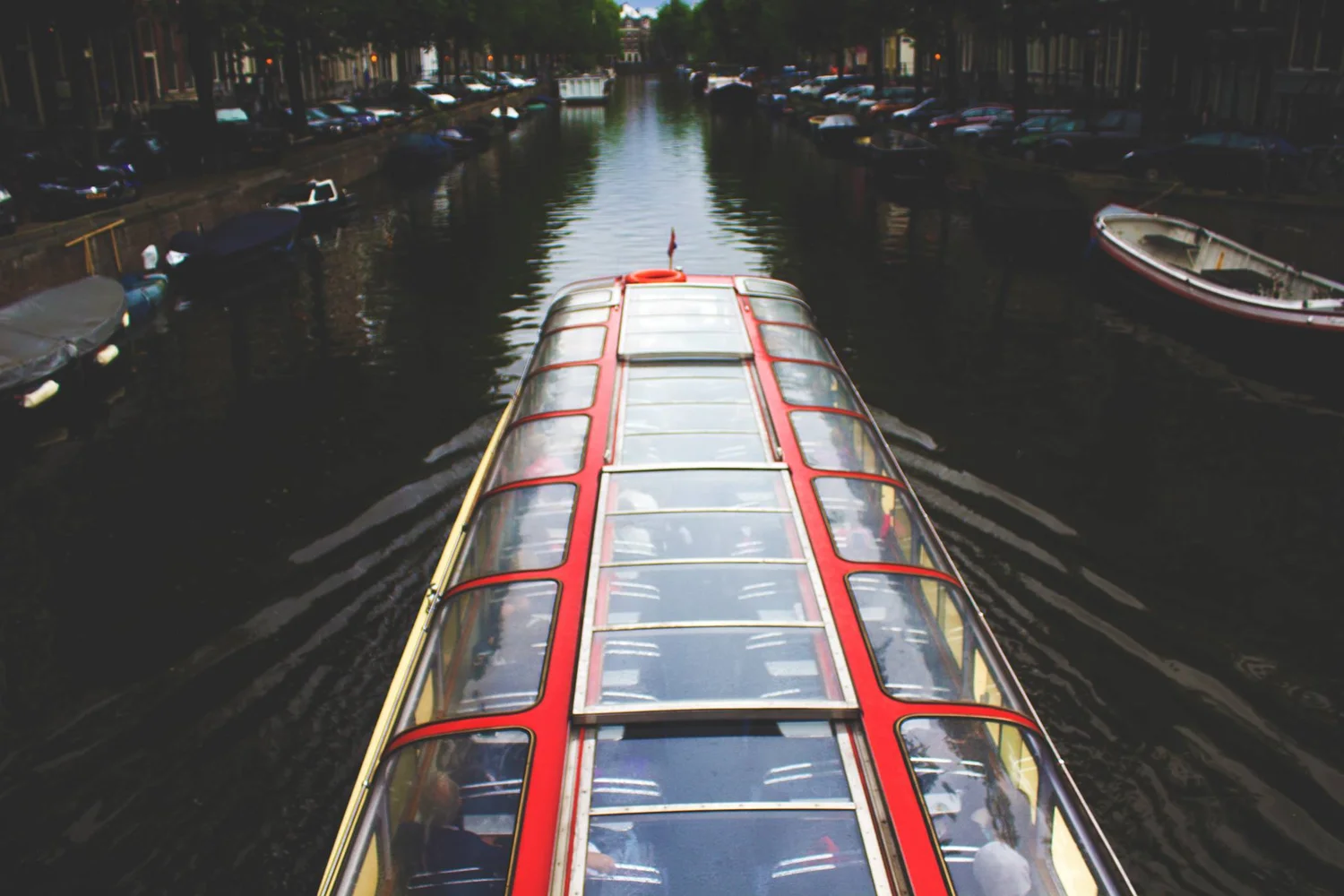
I was so accustomed to tall, rectangular and clear, I had never imagined anything else. Additionally, the endless canals connecting all over were beautiful. Additionally, I was intrigued by the boat homes that lined the canals. They seemed to be something out of a fantasy flick, each one being so colorful and unique to its own. Let’s not forget the colorful homes with windowsills filled with vibrant flowers. They filled the air with life and in way induced a state of euphoria. No I did not take any psychedelics. Furthermore, there was the cobblestone that filled every street. I never loved the sound of footsteps so much. I felt as though I was thrown back into the 1800’s. Walking around Amsterdam was so unique. I was absolutely in love with the colorful city of Amsterdam and even the practice of dodging the endless amounts of bikers roaming the street.

Second off, I fell in love with Amsterdam because of the open-minded culture and people. Within twenty minutes of checking into my hostel I was already out with a few new companions exploring the area. I was amazed at how friendly and inviting people were. I wasn’t being hassled for food or money, but invited for coffee and lunch. People were so interested in learning about other cultures and ways of life. I was bombarded with questions and comments about life in the states. Moreover, everyone was very open to my questions about their culture and what it was like growing up in Amsterdam. I felt so welcomed by the kindness of others.

Perhaps what really made me love Amsterdam was I didn’t feel like I was being watched like all my other stops. People were so open to new ideas and styles that everyone seemed to fit in. Nobody was being pointed at or discriminated against. Everyone had their own unique style and way of life and that was okay. I didn’t realize until I came back to the states how judgmental we can be and how much better life would be if we welcomed one another with open arms.

 I could go on for pages about my adventures in Amsterdam, but this piece is meant to persuade you to visit Amsterdam and help reinvent its image in the states not to ruin the fun for everyone. Yes, Amsterdam has marijuana and the red light district but that isn’t what makes Amsterdam so unique and exciting. Amsterdam is one of a kind because of its unique design from the ground up. Amsterdam is one of a kind because it welcomes people from all walks of life and celebrates the idea of individuality. Amsterdam is one of a kind because it is offers a culture and lifestyle you can find anywhere else. In case you didn’t hear me the first three times, Amsterdam is one of a kind. If you ever intend on traveling the world or even just Europe, Amsterdam is a must see.

Good Shooting,

Kyle